
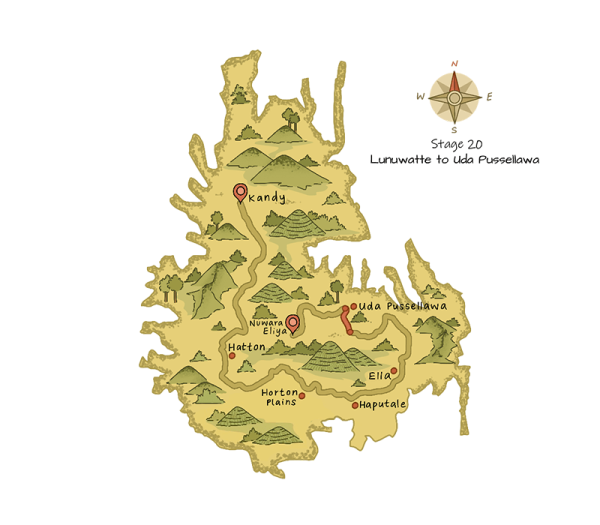
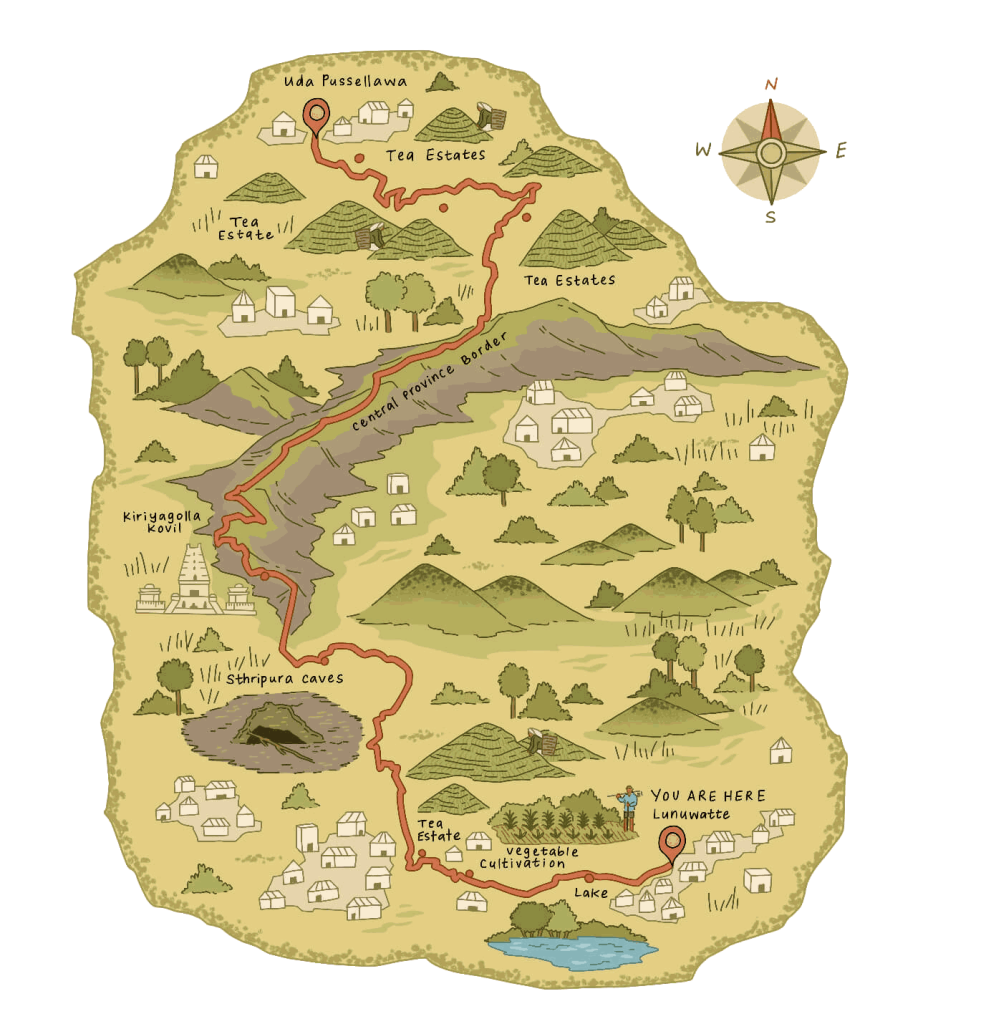
This stage begins in the small hill town of Lunuwatte. Walk on village roads past a lake, paddy fields, and temples. This part of the trail takes you across the quiet countryside of forests and tea plantations with towering eucalyptus and pine trees. There’s plenty of wilderness to experience and enjoy as you follow the trail route.
One of the highlights of this stage is that it takes you past the Sthripura Caves – an important cave network steeped in myths and legends. The name is derived from the Sanskrit and Sinhalese word ‘Sthri’ which means woman, and ‘Pura’ meaning town, and refers to a mythical incident where King Walagamba (77 BC) supposedly hid 500 queens in this very cave in order to protect them.
Trail INFO
Length: 13.63km (8.46 mi)
Average Duration: 4 hours 30 minutes
People Interactions: Low
Region: Ella
Elevation Gain:658m (2,158 ft)
Elevation Loss: 443m (1,453 ft)
Maximum Elevation: 1,613m (5,292 ft)
DIFFICULTY
Forward: Moderate
Reverse: Moderate
Points of Interest
Town – Lunuwatte
Luckyland Estate
Kiriyagolla Kovil
Small Tea Holders Tea Estate
Sthripura Caves
Small Town – Community
Town – Uda Pussallawa
Lake
Emergency Points
TRAIL HEAD/END
The Pekoe Trail Stage 1 begins at: Lunuwatte
The Pekoe Trail Stage 1 ends at: Uda Pussellawa
Stage Description
Today’s stage begins in Ettampitiya, a bustling small town with plenty of shops where you can stock up for the journey ahead. This 18-kilometer stage is split into two distinct sections. The first 8 kilometers involve a gentle descent to the Uma Oya, a remarkable river originating from Pidurutalagala, Sri Lanka’s tallest mountain at 2,524 meters. Eventually merging with the Mahaweli River, the Uma Oya marks a pivotal point on the trail as it signals the start of the gradual ascent to Nuwara Eliya, still four stages away. The latter 10 kilometers lead through some of the most remote and unspoiled areas of tea country, offering a unique landscape reminiscent of Bali’s serene beauty, far removed from typical tourist routes.
The walk begins with a short 150-meter stretch on the main Hali-Ela–Welimada Road before turning right onto a gravel path surrounded by tea fields and scattered village homes. At the 1.1-kilometer mark, the trail connects to a paved village road before veering back onto a tea estate road that descends to the Ettampitiya Estate Bungalow. Continuing downward, the path transitions to a paved village road at the 2.2-kilometer mark, climbing uphill for 700 meters to a fork where we take the right-hand trail.
The path straightens out, descending past village homes and Dehiwwina School on the right. At the 4.4-kilometer mark, we reach the peaceful Pallawela Temple. The descent steepens over the next 2.5 kilometers, dropping about 250 meters in elevation. This section includes a brief stretch of steps before culminating in the charming sight of an old suspension bridge. If the bridge is inaccessible, an alternative concrete path across the riverbed provides a way to cross. This lively area often buzzes with villagers washing clothes or children swimming in the river.
After crossing, we pass a local hydro plant and rejoin the main Hali-Ela–Welimada Road for 700 meters. At the 8.7-kilometer point, we cross the Uma Oya again via a concrete bridge and begin a zig-zagging uphill climb past village homes. By the 9-kilometer mark, breathtaking views of the Uma Oya valley unfold on the right.
At the 11.2-kilometer mark, the trail briefly joins a tarmac road before diverging onto a tea trail, looping back to the road until the 13-kilometer point. Here, the trail peels left and begins a gradual descent, passing a charming temple on the right.
The journey continues on scenic tea trails until the 16.5-kilometer mark, where the trail traverses a picturesque expanse of paddy fields. This enchanting part of the trail evokes memories of Bali’s Ubud region. The path then ascends and descends again to cross another paddy field at the 17.8-kilometer mark. From here, a final 1-kilometer climb along the road brings us to the stage’s endpoint at Lunuwatte.
Responsible interaction with the environment to avoid depletion or degradation of natural resources and allow for long-term environmental quality.
Copyright © 2025 All Rights Reserved. Designed By Apex Innovations